

Multivitamins for kids: a guide for parents
Concerns about ensuring an adequate vitamin supply and questions about the need for multivitamins for children occupy many parents. The desire to optimally support their children’s development often leads many parents to food supplements for adolescents.
Our team at wowtamins, made up of parents and experienced experts, understands these considerations exactly and would like to give you an honest, well-founded overview of the need for multivitamins for children in this article.
- What are multivitamins for children, and are they necessary?
- Multivitamins for children: myths and facts put to the test
- Multivitamins for picky eaters, vegans, and children with chronic conditions
- Make informed decisions
- Important Nutrients and Multivitamins for Children: An Overview
- Conclusion: Multivitamins for children
- Frequently asked questions about multivitamins for children
What are multivitamins for children, and are they necessary?
Food supplements for children (NEM), including multivitamins for children, are legally defined as foods intended to supplement the general diet.¹ They contain micronutrients such as vitamins and minerals in concentrated and measured amounts, for example as tablets, gummy candies, or juices.¹
However, the key question for parents is: Are multivitamins for children really necessary? Experts and scientists still disagree: While some institutes and authorities describe the overall nutrient supply of children and adolescents in Germany as good, current nutrient studies paint a different picture.
For example, the largest current study, EsKiMo II, found that more than 50% of children between 6 and 11 years of age failed to reach the recommended D-A-CH reference values for 9 of the 15 vitamins and minerals studied. Among adolescents aged 12 to 17, 8 (boys) and 9 (girls) nutrients were likewise affected.²
Our all-round gummy supplement for children
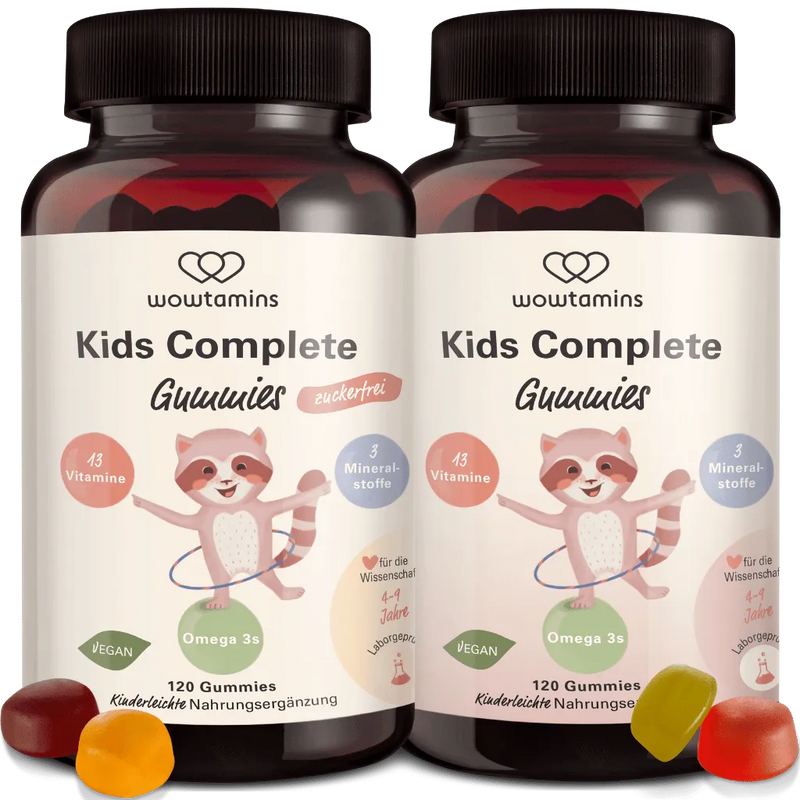
Vitamins, minerals & omega-3s
Children who eat a balanced and healthy diet usually do not need multivitamins—if anything, they may need individual nutrients in specific situations. However, there are certain situations in which broad supplementation may be beneficial after consulting a doctor or healthcare practitioner. For example, for very picky eaters (“Picky Eaters”), children with chronic conditions that impair nutrient absorption, or those following a strictly plant-based diet.
Multivitamins for children: myths and facts put to the test
Many assumptions and promises circulate around the topic of vitamins and dietary supplements for children and teenagers. Taking a critical look helps distinguish facts from myths.
"Multivitamins make my child smarter/more capable."
- Fact is: Vitamins and minerals are essential for maintaining normal bodily functions, including brain function. However, an improvement in academic performance or concentration, for example, can only be expected from additional nutrient intake if there is actually a relevant deficiency impairing these functions.³
This effect has not been scientifically proven in children who are adequately nourished. Rather, a healthy, balanced diet and sufficient exercise have been shown to contribute positively to the development of a child’s brain.⁴ Why omega-3 fatty acids are so important for children for normal brain function is something many parents know—but hardly any child reaches the recommended reference values. However, an excess does not automatically lead to above-average intelligence.⁵
"More is better—more vitamins are always better."
- Fact is: This myth is not only false, but potentially dangerous. The body can only use and process a certain amount of vitamins and minerals effectively.⁵ An overdose, particularly of fat-soluble vitamins (A, D, K, E), which are stored in the body, can cause health problems. The recommended amounts of wowtamins are therefore sufficient for daily needs, but are not excessive and should be followed.
"Natural vitamins are better than synthetic ones."
- The fact is: This question is debated. There is a widespread belief that the body may absorb natural vitamins better and that synthetic forms are inherently bad. However, when criticizing dietary supplements for children, independent experts primarily focus on their general necessity, dosage levels, and product safety, rather than on the source of the vitamins (natural vs. synthetic). The debate over “natural vs. synthetic” can distract from the more fundamental questions of necessity and safety.
"If my child eats poorly, they automatically need multivitamins."
- The fact is: Picky eating or temporarily reduced food intake does not automatically mean that a child has a nutrient deficiency and needs multivitamins. First, the many educational and practical tips for dealing with picky eaters should be tried.
Consultation with a pediatrician or alternative practitioner is necessary to determine whether an actual deficiency exists. Supplements may be useful in cases of persistently unbalanced nutrition, but such a decision should always be based on medical advice and not made as a blanket recommendation.
Do you have any other assumptions or questions about multivitamins for children? Our team of parents and scientific experts will be happy to help!

Multivitamins for picky eaters, vegans, and children with chronic conditions
Although a balanced diet forms the foundation, there are specific situations in which multivitamins for children can provide meaningful support after consultation with a healthcare professional. These include children with highly selective eating habits, known as “picky eaters,” who may be at risk of an inadequate nutrient intake.
Children with chronic conditions that impair nutrient absorption in the intestine (e.g., Crohn’s disease, celiac disease) may also benefit from targeted supplementation to compensate for deficiencies.
A purely plant-based (vegan) diet likewise requires careful monitoring and often supplementation, particularly with vitamin B12, as well as other potentially critical nutrients. Learn more in our article Nutrition and nutrients for vegan & vegetarian children.
Make informed decisions
The most important rule before giving children multivitamins is: Always consult a pediatrician or naturopath first. They can determine whether a deficiency is actually present and whether supplementation is advisable.
Doctors can also recommend child-friendly foods and distinguish dietary supplements from approved medicines. If supplementation is recommended, attention should be paid to age-appropriate dosing and a sensible composition, free from unnecessary or potentially critical additives.
Important Nutrients and Multivitamins for Children: An Overview
There are certain nutrients that are particularly important for children’s development. Here, we have supplemented vitamins with selected minerals and fatty acids:
- Vitamin D: Important for bones and the immune system. Infants receive it prophylactically.⁴
- Vitamin K: Essential for blood clotting; newborns receive prophylaxis.⁶
- Iron: Contributes to cognitive development and is important for oxygen transport.⁴
- Iodine: Important for growth and thyroid function.⁴
- Folic acid (folate): Important for cell division and the formation of new cells.⁴
- Calcium: Necessary for bone growth and development.⁴
- Vitamin B12: Essential for energy metabolism and the nervous system; particularly important to consider with a vegan diet.⁴
- Vitamin A: Important for vision, the immune system, and skin.⁴
- Vitamin C: Strengthens the immune system and promotes iron absorption.⁴
- Vitamin E: Acts as an antioxidant and supports the immune system.⁴
- Other B vitamins: Involved in numerous metabolic processes.⁴
- Omega-3 fatty acids (DHA/EPA): Important for brain and visual development.⁴

Our Omega 3 Gummies with a wow flavor
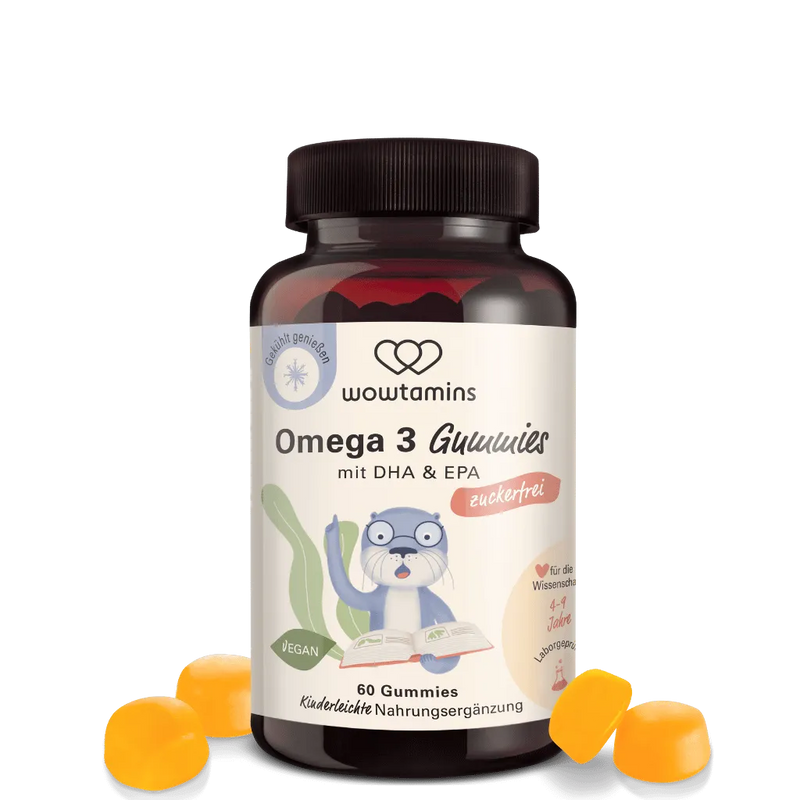
with 1,000 mg (DHA & EPA)
Conclusion: Multivitamins for children
The decision for or against vitamins for children should be carefully considered. The key findings show that healthy children with a balanced diet generally do not need additional multivitamin supplements. Exceptions for picky eaters, chronic illnesses, or certain eating behaviors should ideally be determined after diagnosis and in consultation with a healthcare professional.
An overdose, particularly of fat-soluble vitamins, also poses risks, just like a nutrient deficiency. Therefore, consulting a pediatrician before giving any dietary supplements is essential.
The focus should always be on a varied, natural diet and a healthy lifestyle to promote children's optimal development and health. Parents should critically evaluate advertising claims and rely on independent sources of information as well as their pediatrician's advice to make the best decisions for their child.
Frequently asked questions about multivitamins for children
At what age are multivitamins suitable for children?
Multivitamins are generally available for children aged 4 and over—for babies and toddlers up to 3 years old, different recommendations apply and should always be discussed with a pediatrician. The right dosage form, such as chewable tablets, lozenges, or fruity gummies, makes all the difference: They should be safe and easy to chew. Important: Always keep them out of children's reach to prevent accidental consumption. There is a wide selection on the market—a precise filter by age, ingredients, and features such as “vegan” can help with the choice.
Which B vitamins are especially important for kids?
Especially for kids during the growth phase, vitamins B1, B2, and B6 play a central role:
-
Vitamin B1 contributes to normal energy metabolism.
-
Vitamin B2 contributes to the maintenance of normal skin, nerves, and growth.
-
Vitamin B6 contributes to the normal function of the immune system.
In high-quality vitamin supplements, these micronutrients are dosed appropriately for children and can be combined well with other vitamins.
What should be considered when taking multivitamins?
It is best to take them with a meal so that fat-soluble vitamins in particular can be absorbed optimally. The recommended serving must not be exceeded—as here too, quality comes before quantity. Vitamin supplements are not a substitute for vegetables, fruit & co., but targeted support when needed. For picky eaters or children with special diets, they provide a well-balanced supplement.
Are there differences in taste, quality, and ingredients?
Absolutely—multivitamins on the market differ in taste, form, composition, and additives. Whether chewable tablets with a fruit flavor or gummy bears, taste is a decisive factor in children's regular consumption. Look for clear information about their properties (e.g., low in allergens, no added sugar) and compare customer reviews to get a sense of how they perform in everyday life. And of course, it is worth checking the price—many shops regularly offer discounts.
Sources
[1] https://www.bfr.bund.de/de/fragen_und_antworten_zu_nahrungsergaenzungsmitteln-10700.html
[2] Mensink, Gert B. M. et al. EsKiMo II – The nutrition study as a KiGGS module. Robert Koch Institute. 2020, 1st ed.
[3] Consumer Advice Centre.Caution when buying: consumer warnings about dietary supplements. June 2025.
[4] German Nutrition Society, Austrian Nutrition Society. Reference values for nutrient intake. Bonn, 2nd edition, 8th revised edition (2024).
[5] Press information from the Professional Association of Paediatricians and Adolescent Physicians dated January 13, 2025.
[6] Burgard L. et al. Food consumption and nutrient intake among infants, toddlers, and preschool children. January 2024.
Leave a comment
This site is protected by hCaptcha and the hCaptcha Privacy Policy and Terms of Service apply.