Skip to content

Thiamine - wowtamins Nutrient Guide

Thiamine - wowtamins Nutrient Guide
What is the importance of thiamine for children and adults?

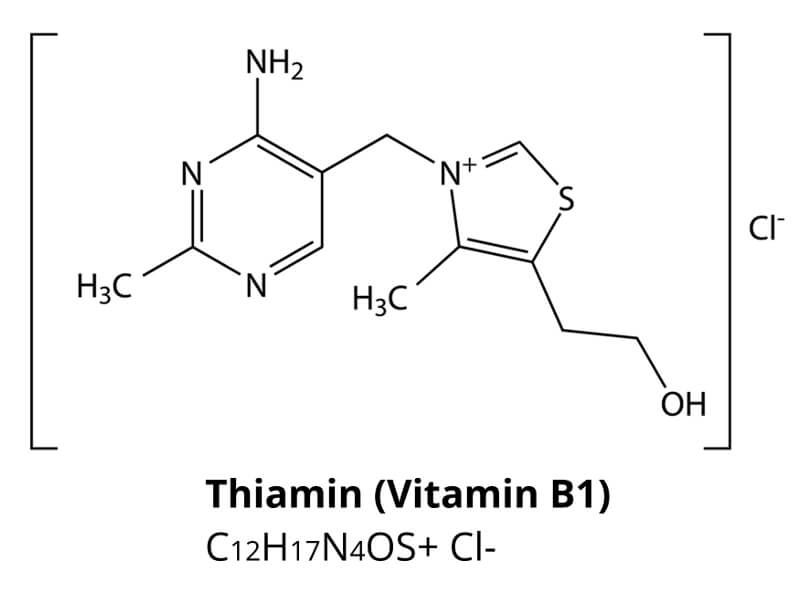
Thiamine refers to the naturally occurring vitamin B1, which belongs to the B-vitamin family. Strictly speaking, thiamine is not a single molecule, but rather an umbrella term for various compounds with similar biological activities.

The most important forms are thiamine monophosphate (TMP), thiamine diphosphate (TDP), and thiamine triphosphate (TTP).

This essential nutrient is water-soluble and found in numerous animal- and plant-based foods. Since our body can store only around 30 milligrams of vitamin B1, we must constantly obtain this vital nutrient from our diet.

Thiamine contributes

  • to normal energy-yielding metabolism
  • to the normal function of the nervous system
  • to normal psychological function
  • to normal heart function

How much thiamine do children need?

The daily thiamine requirement for children and adults was determined by the German Nutrition Society (DGE). The following reference values are the result of a simple conversion.

The DGE uses the reference values for energy intake for children, adolescents, and adults as a basis.

The guideline is: We need around 0.5 milligrams (mg) of vitamin B1 per 1,000 kilocalories of food.

Infants

  • 0 to under 4 months: 0.2 mg*
  • 4 to under 12 months: 0.4 mg

Children

  • 1 to under 4 years: 0.6 mg
  • 4 to under 7 years: 0.7 mg
  • 7 to under 10 years: 0.8 mg (female), 0.9 mg (male)
  • 10 to under 13 years: 0.9 mg (female), 1.0 mg (male)
  • 13 to under 15 years: 1.0 mg (female), 1.2 mg (male)

Adolescents and adults

  • 15 to under 19 years: 1.1 mg (female), 1.4 mg (male)

Men: 1.1–1.3 mg

Women: 1.0 mg

Pregnant women: 1.2 to 1.3 mg

Breastfeeding women: 1.3 mg

Recommended daily minimum amount of thiamine, as of 03/2024. [2]
* Estimated value

In 2003 and 2007, scientists published two comprehensive studies on the diets of children in Germany. While the VELS-study examined the nutrient intake of infants and toddlers, the EsKiMo-study investigated the eating habits of children and adolescents in the 6-to-11 and 12-to-17 age groups.

The results: More than half of girls and boys between 1 and 4 years of age do not get enough thiamine from their diet. [3]

More than 25 percent of children aged 6 to 11 have an inadequate vitamin B1 intake. The situation is hardly better among 12- to 17-year-olds. Nearly one in four female teenagers and one in five male adolescents do not meet the DGE reference values. [4]

According to the National Institutes of Health in the United States (NIH), American children have a significantly better thiamine status: On average, boys and girls between 2 and 5 years of age consume 1.27 milligrams of vitamin B1 daily. [5]

That is more than twice the DGE recommendation. The reason is that cereals, bread, and baby food are fortified with thiamine in the United States. [6]

Where is thiamine found?

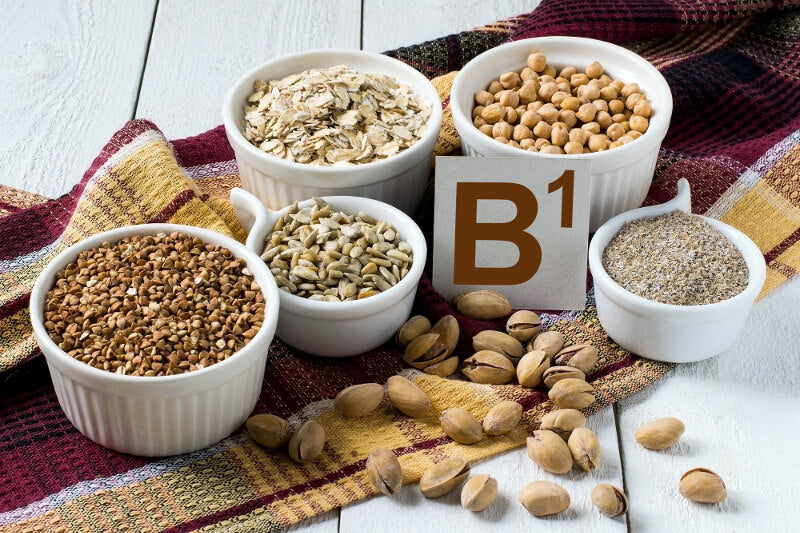
Vitamin B1 is found in plant-based and animal-based foods. This nutrient is essential for humans and can only be stored by the body for about three weeks.

Grain products & vegetables (per 100 g)

  • Sunflower seeds – 1.9 mg
  • Wheat germ – 2.0 mg
  • Peas – 0.76 mg
  • Rolled oats – 0.65 mg
  • Bran – 0.65 mg
  • White beans – 0.5 mg
  • Lentils – 0.45 mg
  • Brown rice – 0.41 mg
  • Rye bread – 0.2 mg
  • Crispbread – 0.2 mg
  • Zucchini – 0.2 mg

Meat & fish (per 100 g)

  • Ham – 1.15 mg
  • Pork tenderloin – 1.1 mg
  • Schnitzel – 0.8 mg
  • Chicken liver – 0.32 mg
  • Beef – 0.23 mg
  • Flounder – 0.22 mg
  • Eel – 0.18 mg
  • Lamb – 0.18 mg

Thiamine content in different foods. [7, 8]

Children aged 4 to under 7 can meet their daily vitamin B1 requirement with a meal consisting of 50 grams each of schnitzel, peas, and brown rice. When preparing food, you should bear in mind that thiamine is sensitive to oxygen and heat. Around one-third of this valuable nutrient is destroyed during cooking or frying.

Thiamine is naturally also found in our products, such as Kids Complete Gummies.

Mandatory notice: Food supplements are not a substitute for a balanced and varied diet and a healthy lifestyle.

List of sources - Thiamine - wowtamins Nutrient Guide

Discover our vitamin gummy categories